Showing posts with label winds. Show all posts

Monday, July 7, 2008

Mistral of France

The Mistral in France is a fresh or cold, often violent, and usually dry wind, blowing throughout the year but is most frequent in winter and spring. It blows from the northwest or north of Europe through the valley of the Rhône River to the Mediterranean.[1] It also affects the whole of Sardinia in Italy.

In the south of France the name comes from the Languedoc dialect of the provençal language and means "masterly." The same wind is called mistrau in the occitan language, mestral in Catalan and maestrale in Italian and Corsican.

The mistral is usually accompanied by clear and sunny weather, and it plays an important role in creating the climate of Provence. It can reach speeds of more than ninety kilometers an hour, particularly in the Rhone Valley.
read on

Sunday, July 6, 2008

Solar Wind


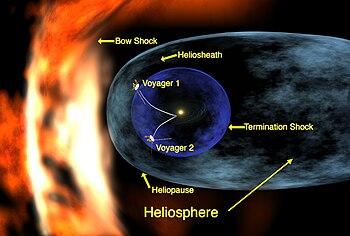
The solar wind is a stream of charged particles—a plasma—that are ejected from the upper atmosphere of the sun. It consists mostly of electrons and protons with energies of about 1 keV. These particles are able to escape the sun's gravity, in part because of the high temperature of the corona, but also because of high kinetic energy that particles gain through a process that is not well-understood at this time.

Many phenomena are directly related to the solar wind, including geomagnetic storms that can knock out power grids on Earth, the aurorae such as the Northern Lights, and the plasma tails of comets that always point away from the sun. While early models of the solar wind used primarily thermal energy to accelerate the material, by the 1960s it was clear that thermal acceleration alone cannot account for the high speed of solar wind. An additional unknown acceleration mechanism is required, and likely relates to magnetic fields in the solar atmosphere.

Saturday, July 5, 2008

Blizzards


Blizzards are severe winter storms that pack a combination of blowing snow and wind resulting in very low visibilities. While heavy snowfalls and severe cold often accompany blizzards, they are not required. Sometimes strong winds pick up snow that has already fallen, creating a blizzard. Officially, the National Weather Service defines a blizzard as large amounts of falling OR blowing snow with winds in excess of 35 mph and visibilities of less than 1/4 of a mile for an extended period of time (greater than 3 hours). When these conditions are expected, the National Weather Service may issue a “Blizzard Warning”. When a less severe, but still dangerous, winter storm is expected a “Winter storm Watch” or “Winter storm Warning” may be issued. A “Winter storm Watch” is issued in advance and means that there is the possibility of a winter storm affecting your area. Keep alert and stay tuned to TV, radio, and other sources of weather information. A “Winter storm Warning” means a winter storm is imminent or already occurring.

Tuesday, July 1, 2008

Buran or Burga/Purga

A strong cold north-easterly wind creating extreme blizzard conditions during winter. The Buran occurs most frequently in Mongolia and Siberia and Buran winds are are strong and full of ice and snow. The skies is often laden with snow which swirls about and reduces the visibility to near zero at times.

This Buran is much feared in the region and can be persistent and close passes for weeks as it blows. Over the tundra it is also known as Purga . In Alaska this severe north-easterly wind is known as Burga bringing snow and ice pellets.

links:http://www.weatheronline.co.uk/reports/wind/The-Buran-or-Burga.htm

Buran or Burga/Purga

A strong cold north-easterly wind creating extreme blizzard conditions during winter. The Buran occurs most frequently in Mongolia and Siberia and Buran winds are are strong and full of ice and snow. The skies is often laden with snow which swirls about and reduces the visibility to near zero at times.

This Buran is much feared in the region and can be persistent and close passes for weeks as it blows. Over the tundra it is also known as Purga . In Alaska this severe north-easterly wind is known as Burga bringing snow and ice pellets.

links:http://www.weatheronline.co.uk/reports/wind/The-Buran-or-Burga.htm