Monday, July 27, 2009
Dysnomia:Moon of Eris
Tuesday, July 21, 2009
Friday, July 3, 2009
Thursday, June 11, 2009
Peculiar, Junior-sized Supernova Discovered By New York Teen
Thursday, May 28, 2009
Astronomers probe close to supermassive black hole's edge
stronomers have used new data from ESA's (European Space Agency's) XMM-Newton spaceborne observatory, to probe closer than ever to a supermassive black hole lying deep at the core of a distant active galaxy.
The galaxy - known as 1H0707-495 - was observed during four 48-hr-long orbits of XMM-Newton around Earth, starting in January 2008.
The black hole at its center was thought to be partially obscured from view by intervening clouds of gas and dust, but these current observations have revealed the innermost depths of the galaxy.
Sunday, March 29, 2009
Saturday, January 31, 2009
Sunday, November 30, 2008
Key Molecule for Life Found in Our Galaxy
The molecule, called glycolaldehyde, was spotted in a large star-forming area of space around 26,000 light-years from Earth in the less-chaotic outer regions of the Milky Way. This suggests the sugar could be common across the universe, which is good news for extraterrestrial-life seekers.
Friday, November 7, 2008
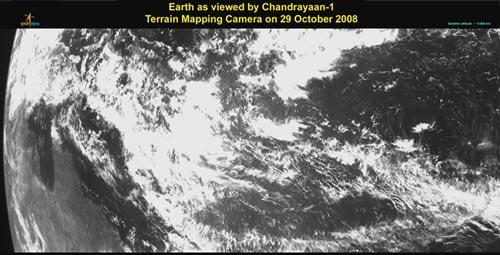
Chandrayaan-1: first images
It was another proud moment for the country. Prime Minister Manmohan Singh was shown the first pictures that were taken by Chandrayaan-1 through the Terrain Mapping Camera on Friday.The TMC was operated in October through a series of commands, which were issued from the Spacecraft Control Centre of the Indian Space Research Organisation Telemetry, Tracking and Command Network in Bengaluru.The first images, which were received by the Indian Deep Space Network at Byalalu was later processed by the Indian Space Science Data Centre. The first images were taken at 8 am from a height of 9,000 km.The Terrain Mapping camera (TMC) on board Chandrayaan-1 spacecraft was successfully operated on October 29, 2008 through a series of commands issued from the Spacecraft Control Centre of ISRO Telemetry, Tracking and Command Network (ISTRAC) at Bangalore.
Analysis of the first imagery received by the Indian Deep Space Network (IDSN) at Byalalu and later processed by Indian Space Science Data Centre (ISSDC) confirms excellent performance of the camera.The first imagery (image 1) taken at 8:00 am IST from a height of 9,000 km shows the Northern coast of Australia while the other (image 2) taken at 12:30 pm from a height of 70,000 km shows Australia’s Southern Coast.
TMC is one of the eleven scientific instruments (payloads) of Chandrayaan-1. The camera can take black and white pictures of an object by recording the visible light reflected from it. The instrument has a resolution of about 5 metres.
Links: ISRO
Saturday, September 20, 2008
The Birth of Eart's Moon: Giant Impact Theory
The Giant Impact, as pictured in a painting by William K. Hartmann on the cover of Natural History Magazine in 1981. Copyright William K. Hartmann
Half an Hour After the Giant Impact, based on computer modeling by A. Cameron, W. Benz, J. Melosh, and others. Copyright William K. Hartmann
Five Hours After Impact, based on computer modeling by A. Cameron, W. Benz, J. Melosh, and others. Copyright William K. Hartmann
Sunday, August 17, 2008
Geoid
Wednesday, August 6, 2008
Phoenix detected Perchlorate in Soil of Mars
Photo credit: NASA/JPL-Caltech/University of Arizona/Texas A&M University
This image was acquired by NASA's Phoenix Mars Lander's Surface Stereo Imager on Sol 43, the 43rd Martian day after landing (July 8, 2008). This image shows the trench informally called "Snow White."
Two samples were delivered to the Wet Chemistry Laboratory, which is part of Phoenix's Microscopy, Electrochemistry, and Conductivity Analyzer (MECA). The first sample was taken from the surface area just left of the trench and informally named "Rosy Red." It was delivered to the Wet Chemistry Laboratory on Sol 30 (June 25, 2008). The second sample, informally named "Sorceress," was taken from the center of the "Snow White" trench and delivered to the Wet Chemistry Laboratory on Sol 41 (July 6, 2008).
Mars mission scientists spoke today on research in progress concerning an ongoing investigation of perchlorate salts detected in soil analyzed by the wet chemistry laboratory aboard NASA's Phoenix Lander.
"Finding perchlorates is neither good nor bad for life, but it does make us reassess how we think about life on Mars," said Michael Hecht of NASA’s Jet Propulsion Laboratory, Pasadena, Calif., lead scientist for the Microscopy, Electrochemistry and Conductivity Analyzer (MECA), the instrument that includes the wet chemistry laboratory.
If confirmed, the result is exciting, Hecht said, "because different types of perchlorate salts have interesting properties that may bear on the way things work on Mars if -- and that's a big 'if ' -- the results from our two teaspoons of soil are representative of all of Mars, or at least a significant portion of the planet."
Read More