Showing posts sorted by relevance for query gypsum. Sort by date Show all posts

Thursday, June 26, 2008

Gypsum


                                                  Gypsum rocks are sedimentary rocks made up of sulfate mineral and formed as the result of evaporating sea water in massive prehistoric basins. It is very soft and is used to make Plaster of Paris, casts, molds, and wallboards
Gypsum rock is usually white or gray, and a freshly broken piece sparkles in the light. Selenite, which is pure gypsum, is the main mineral in gypsum rock; other minerals found in gypsum rock are calcite and anhydrite. It forms from the evaporation of salt-water lakes in semi-desert or desert areas. Gypsum rock is common throughout the United States. It is used to make Plaster of Paris and filler materials.

Gypsum is a soft mineral, hydrous calcium sulfate. Gypsum is the standard for hardness degree 2 on the Mohs mineral hardness scale. Your fingernail will scratch this mineral—that's the simplest way to identify gypsum. The clear variety that makes up this wedge is called selenite after the pearly luster of its cleavage faces, likened to moonlight. 
Gypsum also forms concretions of selenite blades called desert roses or sand roses, growing in sediments that are subjected to concentrated brines. The crystals grow from a central point, and the roses emerge when the matrix weathers away. They don't last long at the surface, just a few years, unless someone collects them. Here's another one.
links:http://www.alientravelguide.com/science/geology/rocks/sediment/gypsum.htm
http://geology.about.com/library/bl/images/bldesertrose.htm
read more

Sunday, May 4, 2008

Mineral Resources from the Ocean

Oceans cover 70 percent of Earth's surface, host a vast variety of geological processes responsible for the formation and concentration of mineral resources, and are the ultimate repository of many materials eroded or dissolved from the land surface. Hence, oceans contain vast quantities of materials that presently serve as major resources for humans. Today, direct extraction of resources is limited to salt; magnesium; placer gold, tin, titanium, and diamonds; and fresh water.

Ancient ocean deposits of sediments and evaporites now located on land were originally deposited under marine conditions. These deposits are being exploited on a very large scale and in preference to modern marine resources because of the easier accessibility and lower cost of terrestrial

These mounds of sea salt were mined from deeply buried beds deposited when sea water evaporated in an ancient environment. The beds were preserved by being covered and then uplifted in a modern terrestrial setting. Mining accounts for most of the annual salt production, even though it also can be obtained by evaporating ocean water.
resources. Yet the increasing population and the exhaustion of readily accessible terrestrial deposits undoubtedly will lead to broader exploitation of ancient deposits and increasing extraction directly from ocean water and ocean basins.

Principal Mineral Resources

Resources presently extracted from the sea or areas that were formerly in the sea range from common construction materials to high-tech metals to water itself. Chemical analyses have demonstrated that sea water contains about 3.5 percent dissolved solids, with more than sixty chemical elements identified. The limitations on extraction of the dissolved elements as well as the extraction of solid mineral resources are nearly always economic, but may also be affected by geographic location (ownership and transport distance) and hampered by technological constraints (depth of ocean basins).

The principal mineral resources presently being extracted and likely to be extracted in the near future are briefly considered here.

Salt.

Salt, or sodium chloride, occurs in sea water at a concentration of about 3 percent and hence constitutes more than 80 percent of the dissolved chemical elements in sea water. The quantity available in all the oceans is so enormous that it could supply all human needs for hundreds, perhaps thousands, of years. Although salt is extracted directly from the oceans in many countries by evaporating the water and leaving the residual salts, most of the nearly 200 million metric tons of salt produced annually is mined from large beds of salt. These beds, now deeply buried, were left when waters from ancient oceans evaporated in shallow seas or marginal basins, leaving residual thick beds of salt; the beds were subsequently covered and protected from solution and destruction.

Potassium.

Like the sodium and chlorine of salt, potassium occurs in vast quantities in sea water, but its average concentration of about 1,300 parts per million (or 0.13 percent) is generally too low to permit direct economic extraction. Potassium salts, however, occur in many thick evaporite sequences along with common salt and is mined from these beds at rates of tens of millions of metric tons per year. The potassium salts were deposited when sea water had been evaporated down to about one-twentieth of its original volume.

Magnesium.

Magnesium, dissolved in sea water at a concentration of about 1,000 parts per million, is the only metal directly extracted from sea water. Presently, approximately 60 percent of the magnesium metal and many of the magnesium salts produced in the United States are extracted from sea water electrolytically. The remaining portion of the magnesium metal and salts is extracted from ancient ocean deposits where the salts precipitated during evaporation or formed during diagenesis. The principal minerals mined for this purpose are magnesite (MgCO3) and dolomite (CaMg[CO3]2).

Sand and Gravel.

The ocean basins constitute the ultimate depositional site of sediments eroded from the land, and beaches represent the largest residual deposits of sand. Although beaches and near-shore sediments are locally extracted for use in construction, they are generally considered too valuable as recreational areas to permit removal for construction purposes. Nevertheless, older beach sand deposits are abundant on the continents, especially the coastal plains, where they are extensively mined for construction materials, glass manufacture, and preparation of silicon metal. Gravel deposits generally are more heterogeneous but occur in the same manner, and are processed extensively for building materials.

Limestone and Gypsum.

Limestones (rocks composed of calcium carbonate) are forming extensively in the tropical to semitropical oceans of the world today as the result of precipitation by biological organisms ranging from mollusks to corals and plants. There is little exploitation of the modern limestones as they are forming in the oceans. However, the continents and tropical islands contain vast sequences of limestones that are extensively mined; these limestones commonly are interspersed with dolomites that formed through diagenetic alteration of limestone. Much of the limestone is used directly in cut or crushed form, but much is also calcined (cooked) to be converted into cement used for construction purposes. Gypsum (calcium sulfate hydrate) forms during evaporation of sea water and thus may occur with evaporite salts and/or with limestones. The gypsum deposits are mined and generally converted into plaster of paris and used for construction.

Manganese Nodules.

The deep ocean floor contains extremely large quantities of nodules ranging from centimeters to decimeters in diameter (that is, from less than an inch to several inches). Although commonly called manganese nodules, they generally contain more iron than manganese, but do constitute the largest known resource of manganese.

Despite the abundance and the wealth of metals contained in manganese nodules (iron, manganese, copper, cobalt, and nickel), no economic way has yet been developed to harvest these resources from the deep ocean floor. Consequently, these rich deposits remain as potential resources for the future. Terrestrial deposits of manganese are still relied on to meet human needs.

Phosphorites.

Complex organic and inorganic processes constantly precipitate phosphate-rich crusts and granules in shallow marine environments. These are the analogs (comparative equivalents) of the onshore deposits being mined in several parts of the world, and represent future potential reserves if land-based deposits become exhausted.

Metal Deposits Associated with Volcanism and Seafloor Vents.

Submarine investigations of oceanic rift zones have revealed that rich deposits of zinc and copper, with associated lead, silver, and gold, are forming at the sites of hot hydrothermal emanations commonly called black smokers. These metal-rich deposits, ranging from chimneyto pancake-like, form where deeply circulating sea water has dissolved metals from the underlying rocks and issue out onto the cold seafloor along major fractures. The deposits forming today are not being mined because of their remote locations, but many analogous ancient deposits are being mined throughout the world.

Placer Gold, Tin, Titanium, and Diamonds.

Placer deposits are accumulations of resistant and insoluble minerals that have been eroded from their original locations of formation and deposited along river courses or at the ocean margins. The most important of these deposits contain gold, tin, titanium, and diamonds.

Today, much of the world's tin and many of the gem diamonds are recovered by dredging near-shore ocean sediments for minerals that were carried into the sea by rivers. Gold has been recovered in the past from such deposits, most notably in Nome, Alaska. Large quantities of placer titanium minerals occur in beach and near-shore sediments, but mining today is confined generally to the beaches or onshore deposits because of the higher costs and environmental constraints of marine mining.

Water.

The world's oceans, with a total volume of more than 500 million cubic kilometers, hold more than 97 percent of all the water on Earth. However, the 3.5-percent salt content of this water makes it unusable for most human needs.

The extraction of fresh water from ocean water has been carried out for many years, but provides only a very small portion of the water used, and remains quite expensive relative to land-based water resources. Technological advances, especially in reverse osmosis, continue to increase the efficiency of fresh-water extraction. However, geographic limitations and dependency on world energy costs pose major barriers to large-scale extraction.

source:http://www.waterencyclopedia.com
Thursday, June 19, 2008

Sinkholes

Dear Readers
It is regarding the earlier post Msterious cracks........
One Earth_Science_India group member Dr. Raed Ahmad has suggested tht these cracks are sinkholes. I am Publishing what he posted.
Sinkholes are common where the rock below the land surface is limestone, carbonate rock, salt beds, or rocks that can naturally be dissolved by ground water circulating through them. As the rock dissolves, spaces and caverns develop underground. Sinkholes are dramatic because the land usually stays intact for a while until the underground spaces just get too big. If there is not enough support for the land above the spaces then a sudden collapse of the land surface can occur. These collapses can be small, as this picture shows, or they can be huge and can occur where a house or road is on top.
What is a "Sinkhole"?
A sinkhole is an area of ground that has no natural external surface drainage--when it rains, all of the water stays inside the sinkhole and typically drains into the subsurface. Sinkholes can vary from a few feet to hundreds of acres and from less than 1 to more than 100 feet deep. Some are shaped like shallow bowls or saucers whereas others have vertical walls; some hold water and form natural ponds. Typically, sinkholes form so slowly that little change is seen in one's life- time, but they can form suddenly when a collapse occurs. Such a collapse can have a dramatic effect if it occurs in an urban setting.
Areas prone to collapse sinkholes
The map below shows areas of the United States where certain rock types that are susceptible to dissolution in water occur. In these areas the formation of underground cavities can form and catastrophic sinkholes can happen. These rock types are evaporites (salt, gypsum, and anhydrite) and carbonates (limestone and dolomite). Evaporite rocks underlie about 35 to 40 percent of the United States, though in many areas they are buried at great depths.

Types of sinkholes
Since Florida is prone to sinkholes, it is a good place to use to discuss some different types of sinkholes and the geologic and hydrologic processes that form them. The processes of dissolution, where surface rock that are soluble to weak acids, are dissolved, and suffosion, where cavities form below the land surface, are responsible for virtually all sinkholes in Florida. 
Dissolution sinkholes
 Dissolution of the limestone or dolomite is most intensive where the water first contacts the rock surface. Aggressive dissolution also occurs where flow is focussed in preexisting openings in the rock, such as along joints, fractures, and bedding planes, and in the zone of water-table fluctuation where ground water is in contact with the atmosphere.
Cover-subsidence sinkholes
Cover-subsidence sinkholes tend to develop gradually where the covering sediments are permeable and contain sand. In areas where cover material is thicker or sediments contain more clay, cover-subsidence sinkholes are relatively uncommon, are smaller, and may go undetected for long periods.
 
Cover-collapse sinkholes
Cover-collapse sinkholes may develop abruptly (over a period of hours) and cause catastrophic damages. They occur where the covering sediments contain a significant amount of clay. Over time, surface drainage, erosion, and deposition of sinkhole into a shallower bowl-shaped depression.
 
Sinkholes can be human-induced
New sinkholes have been correlated to land-use practices, especially from ground-water pumping and from construction and development practices. Sinkholes can also form when natural water-drainage patterns are changed and new water-diversion systems are developed. Some sinkholes form when the land surface is changed, such as when industrial and runoff-storage ponds are created. The substantial weight of the new material can trigger an underground collapse of supporting material, thus causing a sinkhole.
The overburden sediments that cover buried cavities in the aquifer systems are delicately balanced by ground-water fluid pressure. The water below ground is actually helping to keep the surface soil in place. Ground-water pumping for urban water supply and for irrigation can produce new sinkholes In sinkhole-prone areas. If pumping results in a lowering of ground-water levels, then underground structural failure, and thus, sinkholes, can occur.


Friday, April 25, 2008

Sedimentary Rocks

Rivers, oceans, winds, and rain runoff all have the ability to carry the particles washed off of eroding rocks. Such material, called detritus, consists of fragments of rocks and minerals. When the energy of the transporting current is not strong enough to carry these particles, the particles drop out in the process of sedimentation. This type of sedimentary deposition is referred to as clastic sedimentation. Another type of sedimentary deposition occurs when material is dissolved in water, and chemically precipitates from the water. This type of sedimentation is referred to as chemical sedimentation. A third process can occur, wherein living organisms extract ions dissolved in water to make such things as shells and bones. This type of sedimentation is called biogenic sedimentation. Thus, there are three major types of sedimentary rocks: Clastic Sedimentary Rocks, Chemical Sedimentary Rocks, and Biogenic Sedimentary Rocks.

Clastic Sediments

Classification - Clastic sedimentary particles are classified in terms of size

Name of Particle

Size Range

Loose Sediment

Consolidated Rock

Boulder >256 mm Gravel Conglomerate or Breccia (depends on rounding)
Cobble 64 - 256 mm Gravel
Pebble 2 - 64 mm Gravel
Sand 1/16 - 2mm Sand Sandstone
Silt 1/256 - 1/16 mm Silt Siltstone
Clay <1/256> Clay Claystone, mudstone, and shale

The formation of a clastic sedimentary rock involves three processes:

  1. Transportation - Sediment can be transported by sliding down slopes, being picked up by the wind, or by being carried by running water in streams, rivers, or ocean currents. The distance the sediment is transported and the energy of the transporting medium all leave clues in the final sediment that tell us something about the mode of transportation.
  1. Deposition - Sediment is deposited when the energy of the transporting medium becomes too low to continue the transport process. In other words, if the velocity of the transporting medium becomes too low to transport sediment, the sediment will fall out and become deposited. The final sediment thus reflects the energy of the transporting medium.

  2. Diagenesis - Diagenesis is the process that turns sediment into rock. The first stage of the process is compaction. Compaction occurs as the weight of the overlying material increases. Compaction forces the grains closer together, reducing pore space and eliminating some of the contained water. Some of this water may carry mineral components in solution, and these constituents may later precipitate as new minerals in the pore spaces. This causes cementation, which will then start to bind the individual particles together. Further compaction and burial may cause recrystallization of the minerals to make the rock even harder.

    Other conditions present during diagenesis, such as the presence of absence of free oxygen may cause other alterations to the original sediment. In an environment where there is excess oxygen (Oxidizing Environment) organic remains will be converted to carbon dioxide and water. Iron will change from Fe2+ to Fe3+, and will change the color of the sediment to a deep red (rust) color. In an environment where there is a depletion of oxygen (Reducing Environment), organic material may be transformed to solid carbon in the form of coal, or may be converted to hydrocarbons, the source of petroleum.


Textures of Clastic Sedimentary Rocks

When sediment is transported and deposited, it leaves clues to the mode of transport and deposition. For example, if the mode of transport is by sliding down a slope, the deposits that result are generally chaotic in nature, and show a wide variety of particle sizes. Grain size and the interrelationship between grains gives the resulting sediment texture. Thus, we can use the texture of the resulting deposits to give us clues to the mode of transport and deposition.

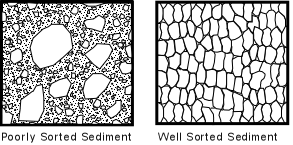
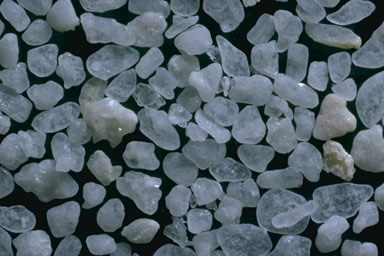
Sorting - The degree of uniformity of grain size. Particles become sorted on the basis of density, because of the energy of the transporting medium. High energy currents can carry larger fragments. As the energy decreases, heavier particles are deposited and lighter fragments continue to be transported. This results in sorting due to density.


If the particles have the same density, then the heavier particles will also be larger, so the sorting will take place on the basis of size. We can classify this size sorting on a relative basis - well sorted to poorly sorted. Sorting gives clues to the energy conditions of the transporting medium from which the sediment was deposited.

Examples

    • Beach deposits and wind blown deposits generally show good sorting because the energy of the transporting medium is usually constant.

    • Stream deposits are usually poorly sorted because the energy (velocity) in a stream varies with position in the stream.

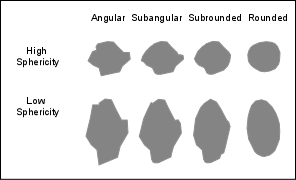
Rounding - During the transportation process, grains may be reduced in size due to abrasion. Random abrasion results in the eventual rounding off of the sharp corners and edges of grains. Thus, rounding of grains gives us clues to the amount of time a sediment has been in the transportation cycle. Rounding is classified on relative terms as well.


Chemical Sediments and Sedimentary Rocks

Cherts - chemically precipitated SiO2

Evaporites - formed by evaporation of sea water or lake water. Produces halite (salt) and gypsum deposits by chemical precipitation as concentration of solids increases due to water loss by evaporation.

Biogenic Sediments and Sedimentary Rocks

Limestone - calcite (CaCO3) is precipitated by organisms usually to form a shell or other skeletal structure. Accumulation of these skeletal remains results in a limestone.

Diatomite - Siliceous ooze consisting of the remains of radiolarian or diatoms can form a light colored soft rock called diatomite.

Coal - accumulation of dead plant matter in large abundance in a reducing environment (lack of oxygen).

Oil Shale - actually a clastic sedimentary rock that contains a high abundance of organic material that is converted to petroleum during diagenesis.

Features of Sedimentary Rocks That Give Clues to the Environment of Deposition

Stratification and Bedding

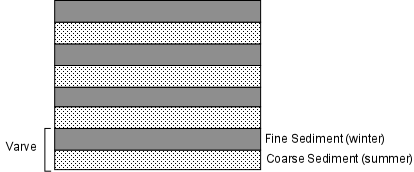
  • Rhythmic Layering - Alternating parallel layers having different properties. Sometimes caused by seasonal changes in deposition (Varves). i.e. lake deposits wherein coarse sediment is deposited in summer months and fine sediment is deposited in the winter when the surface of the lake is frozen.
  • Cross Bedding - Sets of beds that are inclined relative to one another. The beds are inclined in the direction that the wind or water was moving at the time of deposition. Boundaries between sets of cross beds usually represent an erosional surface. Very common in beach deposits, sand dunes, and river deposited sediment.
  • Graded Bedding - As current velocity decreases, first the larger or more dense particles are deposited followed by smaller particles. This results in bedding showing a decrease in grain size from the bottom of the bed to the top of the bed.
  • Non-sorted Sediment - Sediment showing a mixture of grain sizes results from such things as rockfalls, debris flows, mudflows, and deposition from melting ice.

Surface Features
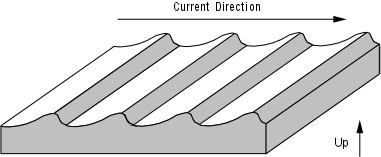
  • Ripple Marks - Characteristic of shallow water deposition. Caused by waves or winds.

  • Mudcracks - result from the drying out of wet sediment at the surface of the Earth. The cracks form due to shrinkage of the sediment as it dries.

  • Raindrop Marks - pits (or tiny craters) created by falling rain. If present, this suggests that the sediment was exposed to the surface of the Earth.

  • Fossils - Remains of once living organisms. Probably the most important indicator of the environment of deposition.
    • Different species usually inhabit specific environments.

    • Because life has evolved - fossils give clues to relative age of the sediment.

    • Can also be important indicators of past climates.

Color

  • Iron oxides and sulfides along with buried organic matter give rocks a dark color. Indicates deposition in a reducing environment.

  • Deposition in oxidizing environment produces red colored iron oxides.

Sedimentary Facies

A sedimentary facies is a group of characteristics which reflect a sedimentary environment different from those elsewhere in the same deposit. Thus, facies may change vertically through a sequence as a result of changing environments through time. Also, facies may change laterally through a deposit as a result of changing environments with distance at the same time.

Common Sedimentary Environments

  • Non-marine environments

    • Stream sediments

    • Lake sediments

    • Glacial (ice deposited) sediments

    • Eolian (wind deposited) sediments

  • Continental Shelf sediments

    • Estuarine sediments

    • Deltaic sediments

    • Beach sediments

    • Carbonate shelf sediments

    • Marine evaporite sediments

  • Continental slope and rise sediments

    • Turbidites

    • Deep Sea Fans

    • Sediment drifts

  • Deep Sea Sediments

    • Deep -Sea oozes

    • Land-derived sediments
Source:http://www.tulane.edu
see more