Saturday, May 24, 2008

Water Pollution

When toxic substances enter lakes, streams, rivers, oceans, and other water bodies, they get dissolved or lie suspended in water or get deposited on the bed. This results in the pollution of water whereby the quality of the water deteriorates, affecting aquatic ecosystems. Pollutants can also seep down and affect the groundwater deposits.

Water pollution has many sources. The most polluting of them are the city sewage and industrial waste discharged into the rivers. The facilities to treat waste water are not adequate in any city in India. Presently, only about 10% of the waste water generated is treated; the rest is discharged as it is into our water bodies. Due to this, pollutants enter groundwater, rivers, and other water bodies. Such water, which ultimately ends up in our households, is often highly contaminated and carries disease-causing microbes. Agricultural run-off, or the water from the fields that drains into rivers, is another major water pollutant as it contains fertilizers and pesticides.

Domestic sewage refers to waste water that is discarded from households. Also referred to as sanitary sewage, such water contains a wide variety of dissolved and suspended impurities. Biochemical oxygen demand, or BOD

The amount of organic material that can rot in the sewage is measured by the biochemical oxygen demand. BOD is the amount of oxygen required by micro-organisms to decompose the organic substances in sewage. Therefore, the more organic material there is in the sewage, the higher the BOD. It is among the most important parameters for the design and operation of sewage treatment plants. BOD levels of industrial sewage may be many times that of domestic sewage. Dissolved oxygen is an important factor that determines the quality of water in lakes and rivers. The higher the concentration of dissolved oxygen, the better the water quality. When sewage enters a lake or stream, micro-organisms begin to decompose the organic materials. Oxygen is consumed as micro-organisms use it in their metabolism. This can quickly deplete the available oxygen in the water. When the dissolved oxygen levels drop too low, many aquatic species perish. In fact, if the oxygen level drops to zero, the water will become septic. When organic compounds decompose without oxygen, it gives rise to the undesirable odours usually associated with septic or putrid conditions.


It amounts to a very small fraction of the sewage by weight. But it is large by volume and contains impurities such as organic materials and plant nutrients that tend to rot. The main organic materials are food and vegetable waste, plant nutrient come from chemical soaps, washing powders, etc. Domestic sewage is also very likely to contain disease-causing microbes. Thus, disposal of domestic waste water is a significant technical problem. Sewage generated from the urban areas in India has multiplied manifold since 1947.

Today, many people dump their garbage into streams, lakes, rivers, and seas, thus making water bodies the final resting place of cans, bottles, plastics, and other household products. The various substances that we use for keeping our houses clean add to water pollution as they contain harmful chemicals. In the past, people mostly used soaps made from animal and vegetable fat for all types of washing. But most of today’s cleaning products are synthetic detergents and come from the petrochemical industry. Most detergents and washing powders contain phosphates, which are used to soften the water among other things. These and other chemicals contained in washing powders affect the health of all forms of life in the water.

Agricultural Run off
Eutrophication

When fresh water is artificially supplemented with nutrients, it results in an abnormal increase in the growth of water plants. This is known as eutrophication. The discharge of waste from industries, agriculture, and urban communities into water bodies generally stretches the biological capacities of aquatic systems. Chemical run-off from fields also adds nutrients to water. Excess nutrients cause the water body to become choked with organic substances and organisms. When organic matter exceeds the capacity of the micro-organisms in water that break down and recycle the organic matter, it encourages rapid growth, or blooms, of algae. When they die, the remains of the algae add to the organic wastes already in the water; eventually, the water becomes deficient in oxygen. Anaerobic organisms (those that do not require oxygen to live) then attack the organic wastes, releasing gases such as methane and hydrogen sulphide, which are harmful to the oxygen-requiring (aerobic) forms of life. The result is a foul-smelling, waste-filled body of water. This has already occurred in such places as Lake Erie and the Baltic Sea, and is a growing problem in freshwater lakes all over India. Eutrophication can produce problems such as bad tastes and odours as well as green scum algae. Also the growth of rooted plants increases, which decreases the amount of oxygen in the deepest waters of the lake. It also leads to the death of all forms of life in the water bodies.


The use of land for agriculture and the practices followed in cultivation greatly affect the quality of groundwater. Intensive cultivation of crops causes chemicals from fertilizers (e.g. nitrate) and pesticides to seep into the groundwater, a process commonly known as leaching. Routine applications of fertilizers and pesticides for agriculture and indiscriminate disposal of industrial and domestic wastes are increasingly being recognized as significant sources of water pollution.

The high nitrate content in groundwater is mainly from irrigation run-off from agricultural fields where chemical fertilizers have been used indiscriminately.


Industrial effluents

Waste water from manufacturing or chemical processes in industries contributes to water pollution. Industrial waste water usually contains specific and readily identifiable chemical compounds. During the last fifty years, the number of industries in India has grown rapidly. But water pollution is concentrated within a few subsectors, mainly in the form of toxic wastes and organic pollutants. Out of this a large portion can be traced to the processing of industrial chemicals and to the food products industry. In fact, a number of large- and medium-sized industries in the region covered by the Ganga Action Plan do not have adequate effluent treatment facilities. Most of these defaulting industries are sugar mills, distilleries, leather processing industries, and thermal power stations. Most major industries have treatment facilities for industrial effluents. But this is not the case with small-scale industries, which cannot afford enormous investments in pollution control equipment as their profit margin is very slender.

Effects of water pollution

The effects of water pollution are not only devastating to people but also to animals, fish, and birds. Polluted water is unsuitable for drinking, recreation, agriculture, and industry. It diminishes the aesthetic quality of lakes and rivers. More seriously, contaminated water destroys aquatic life and reduces its reproductive ability. Eventually, it is a hazard to human health. Nobody can escape the effects of water pollution.

The individual and the community can help minimize water pollution. By simple housekeeping and management practices the amount of waste generated can be minimized.
click here

Friday, May 23, 2008

Prevention of Acid Rain

a) Require catalytic converters on auto & truck engines & factory smoke stacks.

b) Require that all chemical wastes be neutralized before disposal.

c) Convert to hydrogen fuels, solar or wind for energy.

Thursday, May 22, 2008

Metamorhic Rocks

How Metamorphic Rock Is Formed


Metamorphic rocks are rocks that have "morphed" into another kind of rock. These rocks were once igneous or sedimentary rocks. How do sedimentary and igneous rocks change? The rocks are under tons and tons of pressure, which fosters heat build up, and this causes them to change. If you exam metamorphic rock samples closely, you'll discover how flattened some of the grains in the rock are.

Examples
Schist Rocks
Schist rocks are metamorphic. These rocks can be formed from basalt, an igneous rock; shale, a sedimentary rock; or slate, a metamorphic rock. Through tremendous heat and pressure, these rocks were transformed into this new kind of rock.
Gneiss Rocks
Gneiss rocks are metamorphic. These rocks may have been granite, which is an igneous rock, but heat and pressure changed it. You can see how the mineral grains in the rock were flattened through tremendous heat and pressure and are arranged in alternating patterns.

source:http://sln.fi.edu/fellows/payton/rocks/expert/gneiss.htm

Exploding star caught in the act


Science reporter, BBC News


The outburst was spotted by the Swift space telescope


Astronomers have been able to capture and record the first moments when a massive star blows itself apart.

After decades of searching, researchers have used the world's top telescopes to observe the remarkable event.

Previously, scientists had only been able to study these "supernovas" several days after the event.

The results, published in the journal Nature, show that within two hours of the blast, a giant fireball scattered radioactive debris across space.
We were in the right place, at the right time
Alicia Soderberg, Princeton University


Exploding stars, or supernovas, are some of the most spectacular events in the Universe, producing the same amount of energy as trillions of nuclear bombs detonating simultaneously.

Typically, they occur when a massive star - more than eight times the mass of the Sun - runs out of fuel and collapses to form a hot relic called a neutron star.

Their extreme brightness allows them to be seen in distant galaxies.

But observers cannot pick up this optical emission until several hours or days after the explosion, so a supernova's first moments are shrouded in mystery.

Death of a star

The event in the constellation of Lynx was captured by pure chance.

Alicia Soderberg, from Princeton University in New Jersey, and her colleagues were using the Swift space telescope to survey the spiral galaxy NGC2770.

They saw an extremely luminous X-ray outburst in an area of sky that had shown nothing bright just two days earlier.

They attribute the outburst to the breaking out of the supernova shockwave, which ploughs its way through the star's gaseous outer layers - blowing it to smithereens.

"We were in the right place, at the right time, with the right telescope," Dr Soderberg explained.

The initial observations were followed up by some of the world's major telescopes. They observed the blast for more than 30 days to rule out the possibility this event could be anything other than a supernova.

"We were able to observe the evolution of the explosion right from the start,” said co-author Edo Berger, from the Carnegie Observatories in California.

"This eventually confirmed that the big X-ray blast marked the birth of a supernova."

Dr Kim Page, from the University of Leicester, who led the X-ray analysis, commented: "This observation is by far the best example of what happens when a star dies and a neutron star is born."

Astronomers say that supernovas are part of the story of how we came to be, because these tremendous explosions created many of the heavy elements from which planets are made.

The authors say the event will help astronomers fill in gaps about the properties of massive stars, the birth of neutron stars and black holes, and the impact of supernovas on their environments.

source:http://news.bbc.co.uk/1/hi/sci/tech/7413160.stm

Urgent :GRASS GIS Contractor needed - Sydney

Job Location(s):
Australia
New South Wales - Sydney
This role is only available to residents of Australia
or to those who hold valid working visas or permits

Do you have skills using GRASS GIS?

Our Sydney CBD based research company has an immediate need for someone who has a good understanding of the open source GIS - GRASS.

Initially a three month contract but for the right person it could become a permanent role.

Our client is seeking someone with the following skills:

* GRASS GIS
* SQL (especially the use of MySQL)
* Understanding of the telecommuncations industry
* Understanding of national GIS datasets including ABS, LGA, Telstra exchange

Our client is seeking a good team player to fit into this growing market research organisation.
Additional Information
Position Type: Full Time, 3 months plus
To be considered for the role please apply online with the following:

1. A current resume in word format
2. A covering letter describing your GRASS and SQL skills
3. When you would be available to start and
4. Your preferred hourly rate

For more information contact Dean Howell on 0417 805 998
CONTACT INFORMATION
GISjobs International
Dean Howell
Mobile Number: 0417 805 998
Follow this link to Apply Online

Wednesday, May 21, 2008

Mobile GIS aids inspection and monitoring efforts that safeguard storm water runoff.

click here

Tropical Rainforests


">  
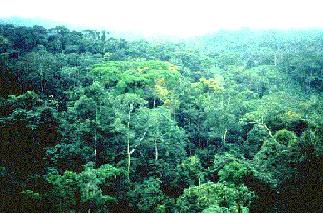
The tropical rain forest is a forest of tall trees in a region of year-round warmth. An average of 50 to 260 inches (125 to 660 cm.) of rain falls yearly.

Rain forests belong to the tropical wet climate group. The temperature in a rain forest rarely gets higher than 93 °F (34 °C) or drops below 68 °F (20 °C); average humidity is between 77 and 88%; rainfall is often more than 100 inches a year. There is usually a brief season of less rain. In monsoonal areas, there is a real dry season. Almost all rain forests lie near the equator.

Rainforests now cover less than 6% of Earth's land surface. Scientists estimate that more than half of all the world's plant and animal species live in tropical rain forests. Tropical rainforests produce 40% of Earth's oxygen.

A tropical rain forest has more kinds of trees than any other area in the world. Scientists have counted about 100 to 300 species in one 2 1/2-acre (1-hectare) area in South America. Seventy percent of the plants in the rainforest are trees.

About 1/4 of all the medicines we use come from rainforest plants. Curare comes from a tropical vine, and is used as an anesthetic and to relax muscles during surgery. Quinine, from the cinchona tree, is used to treat malaria. A person with lymphocytic leukemia has a 99% chance that the disease will go into remission because of the rosy periwinkle. More than 1,400 varieties of tropical plants are thought to be potential cures for cancer.

All tropical rain forests resemble one another in some ways. Many of the trees have straight trunks that don't branch out for 100 feet or more. There is no sense in growing branches below the canopy where there is little light. The majority of the trees have smooth, thin bark because there is no need to protect the them from water loss and freezing temperatures. It also makes it difficult for epiphytes and plant parasites to get a hold on the trunks. The bark of different species is so similar that it is difficult to identify a tree by its bark. Many trees can only be identified by their flowers.

Despite these differences, each of the three largest rainforests--the American, the African, and the Asian--has a different group of animal and plant species. Each rain forest has many species of monkeys, all of which differ from the species of the other two rain forests. In addition, different areas of the same rain forest may have different species. Many kinds of trees that grow in the mountains of the Amazon rain forest do not grow in the lowlands of that same forest.


Layers of the Rainforest

There are four very distinct layers of trees in a tropical rain forest. These layers have been identified as the emergent, upper canopy, understory, and forest floor.
Emergent trees are spaced wide apart, and are 100 to 240 feet tall with umbrella-shaped canopies that grow above the forest. Because emergent trees are exposed to drying winds, they tend to have small, pointed leaves. Some species lose their leaves during the brief dry season in monsoon rainforests. These giant trees have straight, smooth trunks with few branches. Their root system is very shallow, and to support their size they grow buttresses that can spread out to a distance of 30 feet.
The upper canopy of 60 to 130 foot trees allows light to be easily available at the top of this layer, but greatly reduced any light below it. Most of the rainforest's animals live in the upper canopy. There is so much food available at this level that some animals never go down to the forest floor. The leaves have "drip spouts" that allows rain to run off. This keeps them dry and prevents mold and mildew from forming in the humid environment.
The understory, or lower canopy, consists of 60 foot trees. This layer is made up of the trunks of canopy trees, shrubs, plants and small trees. There is little air movement. As a result the humidity is constantly high. This level is in constant shade.
The forest floor is usually completely shaded, except where a canopy tree has fallen and created an opening. Most areas of the forest floor receive so little light that few bushes or herbs can grow there. As a result, a person can easily walk through most parts of a tropical rain forest. Less than 1 % of the light that strikes the top of the forest penetrates to the forest floor. The top soil is very thin and of poor quality. A lot of litter falls to the ground where it is quickly broken down by decomposers like termites, earthworms and fungi. The heat and humidity further help to break down the litter. This organic matter is then just as quickly absorbed by the trees' shallow roots.


Plant Life

Besides these four layers, a shrub/sapling layer receives about 3 % of the light that filters in through the canopies. These stunted trees are capable of a sudden growth surge when a gap in the canopy opens above them.

The air beneath the lower canopy is almost always humid. The trees themselves give off water through the pores (stomata) of their leaves. This process, called transpiration, can account for as much as half of the precipitation in the rain forest.

Rainforest plants have made many adaptations to their environment. With over 80 inches of rain per year, plants have made adaptations that helps them shed water off their leaves quickly so the branches don't get weighed down and break. Many plants have drip tips and grooved leaves, and some leaves have oily coatings to shed water. To absorb as much sunlight as possible on the dark understory, leaves are very large. Some trees have leaf stalks that turn with the movement of the sun so they always absorb the maximum amount of light. Leaves in the upper canopy are dark green, small and leathery to reduce water loss in the strong sunlight. Some trees will grow large leaves at the lower canopy level and small leaves in the upper canopy. Other plants grow in the upper canopy on larger trees to get sunlight. These are the epiphytes such as orchids and bromeliads. Many trees have buttress and stilt roots for extra support in the shallow, wet soil of the rainforests.

Over 2,500 species of vines grow in the rainforest. Lianas start off as small shrubs that grow on the forest floor. To reach the sunlight in the upper canopy it sends out tendrils to grab sapling trees. The liana and the tree grow towards the canopy together. The vines grow from one tree to another and make up 40% of the canopy leaves. The rattan vine has spikes on the underside of its leaves that point backwards to grab onto sapling trees. Other "strangler" vines will use trees as support and grow thicker and thicker as they reach the canopy, strangling its host tree. They look like trees whose centers have been hollowed out.

Dominant species do not exist in tropical rainforests. Lowland dipterocarp forest can consist of many different species of Dipterocarpaceae, but not all of the same species. Trees of the same species are very seldom found growing close together. This bio diversity and separation of the species prevents mass contamination and die-off from disease or insect infestation. Bio diversity also insures that there will be enough pollinators to take care of each species' needs. Animals depend on the staggered blooming and fruiting of rainforest plants to supply them with a year-round source of food.


Animal Life

Many species of animal life can be found in the rain forest. Common characteristics found among mammals and birds (and reptiles and amphibians, too) include adaptations to a life in the trees, such as the prehensile tails of New World monkeys. Other characteristics are bright colors and sharp patterns, loud vocalizations, and diets heavy on fruits.

Insects make up the largest single group of animals that live in tropical forests. They include brightly colored butterflies, mosquitoes, camouflaged stick insects, and huge colonies of ants.

The Amazon river basin rainforest contains a wider variety of plant and animal life than any other biome in the world. The second largest population of plant and animal life can be found in scattered locations and islands of Southeast Asia. The lowest variety can be found in Africa. There may be 40 to 100 different species in 2.5 acres ( 1 hectare) of a tropical rain forest.


When early explorers first discovered the rainforests of Africa, Southeast Asia and South America, they They were amazed by the dense growth, trees with giant buttresses, vines and epiphytes . The tropical vegetation grew so dense that it was difficult to cut one's way through it. It was thought at the time that the soil of a rainforest must be very fertile, filled with nutrients, enabling it to support the immense trees and other vegetation they found.

Today we know that the soil of the tropical rainforests is shallow, very poor in nutrients and almost without soluble minerals. Thousands of years of heavy rains have washed away the nutrients in the soil obtained from weathered rocks. The rainforest has a very short nutrient cycle. Nutrients generally stay in an ecosystem by being recycled and in a rainforest are mainly found in the living plants and the layers of decomposing leaf litter. Various species of decomposers like insects, bacteria, and fungi make quick work of turning dead plant and animal matter into nutrients. Plants take up these nutrients the moment they are released.

A study in the Amazon rainforest found that 99% of nutrients are held in root mats. When a rainforest is burned or cut down the nutrients are removed from the ecosystem. The soil can only be used for a very short time before it becomes completely depleted of all nutrients.


Where the Rainforests Are Found

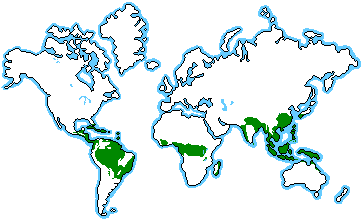
The tropical rain forest can be found in three major geographical areas around the world.
Central America in the the Amazon river basin.
Africa - Zaire basin, with a small area in West Africa; also eastern Madagascar.
Indo-Malaysia - west coast of India, Assam, Southeast Asia, New Guinea and Queensland, Australia.


read more

Rapid Scanning Service From Eumetsat Increases Imagery

14 May 2008
Yesterday, Meteosat-8 started the new Rapid Scanning Service (RSS), which replaces the Meteosat-6 RSS which ended in January 2007. Meteosat-8 will deliver Meteosat Second Generation (MSG) image data as well as a selection of meteorological products. Rapid scan data from the new service complements the 15-minute High Resolution Image data generated by the operational Meteosat satellite, Meteosat-9. The scan period is five minutes, compared to 10 minutes for the previous service. It is now the same as that of European weather radars, making it even more useful in monitoring rapidly developing localized, convective weather systems, such as thunder storms. The scan will cover a latitude range of 15° to 70°. The image data and products will be based on the full 12 spectral channels available from MSG.

At the end of April, Meteosat-8 was relocated to 9.5° E, from where it will deliver the new RSS and continue to be a backup satellite for Meteosat-9. The image data service was declared operational on May 13th, with the start date for operational dissemination of RSS meteorological products still to be determined. RSS products will include Atmospheric Motion Vectors extracted every 20 minutes; Clear Sky Radiances extracted every 15 minutes; and Multi-sensor Precipitation Estimate, Active Fire Monitoring, and Global Instability Index extracted every five minutes. They will be distributed via EUMETCast-Europe and on the World Meteorological Organization’s Global Telecommunication System and continue to be archived at EUMETSAT.

The original RSS began in September 2001, using the 1G Meteosat-6. Originally used to support the Mesoscale Alpine Programme, RSS was continued in response to a more general demand from the user community for more frequent imagery over Europe than the standard 30-minute intervals available with 1G Meteosat satellites. RSS, provided by the Meteosat-6 satellite positioned at 10° E, generated image data covering Europe at 10-minute intervals

Source : http://www.satnews.com/